
Western states are no longer just paying people to remove lawns. Some are now making it the law.
Across Nevada, California, Arizona, and Colorado, turf removal programs continue to accelerate, driven by historic drought, shrinking reservoir levels, and a simple reality. Ornamental grass consumes more water than arid regions can sustain. Rebates now range from $2 to $10 per square foot, depending on the market. In Southern Nevada, a first-of-its-kind law requires commercial and HOA properties to remove nonfunctional turf entirely by the end of 2026.
For landscape supply dealers, this shift represents the largest demand driver for decorative stone in a generation. Most yards have not started talking about it yet.
The Mandate Is Here. Decorative Rock Is Written Into It
Nevada’s Assembly Bill 356 is the sharpest example. Signed in 2021, the law prohibits the use of Colorado River water to irrigate non-functional turf on commercial properties, multifamily housing, HOA common areas, and government land. The deadline to remove it is December 31, 2026. This requirement is not optional. The Southern Nevada Water Authority estimates the measure will save 9.5 billion gallons of water annually, or roughly 10% of the region’s total supply.
Nevada is not alone. Southern California’s Metropolitan Water District offers a base rebate of $3 per square foot, with individual water districts adding incentives that push totals to $7 or more in areas such as Pasadena. Within LADWP territory, commercial properties can now receive up to $9 per square foot. Programs in Scottsdale, Gilbert, and Chandler have drawn such strong demand that they closed early and later reopened with expanded budgets. Colorado continues to move in the same direction.
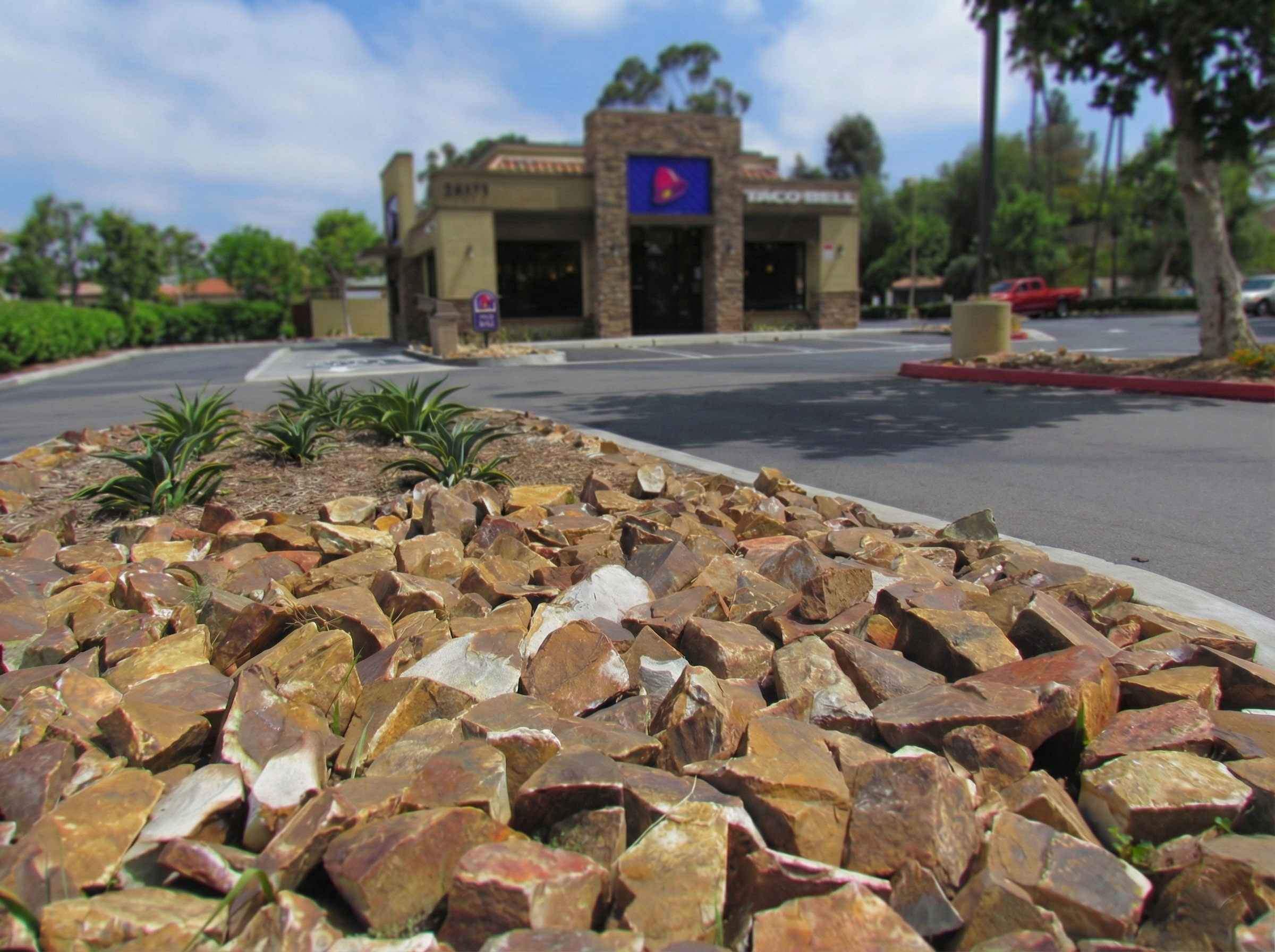
Here is the detail that matters most for this industry. Nearly every one of these programs explicitly lists decorative rock as an approved replacement material. Nevada’s law specifies permeable materials such as mulch, decorative rock, or water-smart synthetic turf. California requires replacement areas to remain permeable, with rock gardens listed as qualifying stormwater retention features. Arizona programs approve inorganic top dressing, including gravel, river rock, and decorative stone.
Decorative rock appears directly in the compliance specifications of these programs.
The Case Nobody’s Making: Decorative Stone vs. Artificial Turf
Artificial turf companies currently dominate this conversation. They have built landing pages, cost calculators, and blog content that tie their products to nearly every rebate program in the West. A search for AB 356 compliance or turf rebate replacement options surfaces synthetic grass companies on the first page. Stone suppliers remain largely invisible.
That gap reflects a positioning issue rather than a product limitation. The case for decorative stone compared to artificial turf continues to strengthen.
Artificial turf presents several challenges under desert conditions:
- UV exposure shortens surface life, with replacement cycles of 8 to 15 years.
- Surface temperatures can exceed 150°F in direct sun.
- Heat retention contributes to urban heat island concerns.
- Synthetic fibers shed microplastics.
- Several rebate programs now exclude or restrict eligibility for artificial turf, including the Chandler, Arizona, and the SoCal Water$mart programs.
Decorative stone addresses each of these concerns. Premium natural materials such as Mexican Beach Pebbles, Curran Cobble, and Baja Crested Red Rubble remain fully permeable and meet drainage requirements across programs. Stone does not degrade under UV exposure, requires no replacement cycle, and introduces no microplastics. It maintains lower surface temperatures than synthetic alternatives, requires no ongoing maintenance, and develops a more natural appearance over time as it weathers into the landscape.
Regulations across Western markets increasingly favor stone-based solutions. Dealers who clearly explain these advantages are well-positioned to capture growing demand in the replacement materials market.
Your Customers Are About to Start Asking
Properties required to comply, contractors completing rebate projects, and homeowners using incentives of $3 to $10 per square foot all need materials. Landscape supply yards that understand this shift and can guide the conversation will capture that demand. Others will see it move toward synthetic turf installers and big-box retailers. Make sure your staff are trained on this topic before the rush kicks in.
We created a one-page guide that counter teams can use immediately. It outlines the key talking points on decorative stone as a replacement material, summarizes typical rebate ranges, and directs customers to their local water district for program details.