

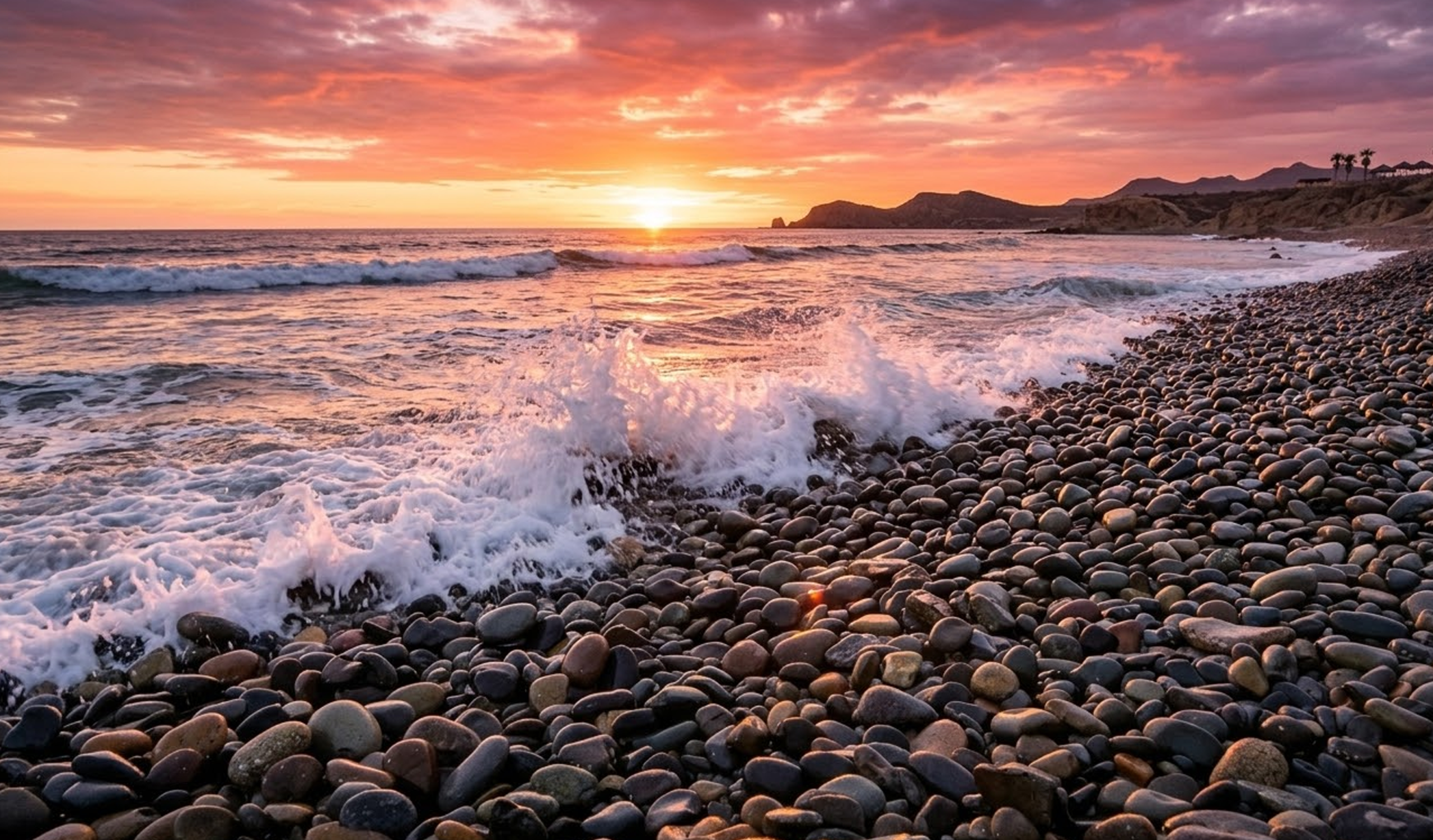
Most people assume stone quality is consistent year-round. Order in January, order in July, get the same product. But when it comes to Mexican Beach Pebbles, spring is when you get the best stone. There is a real, measurable reason for that, and it starts thousands of miles offshore.
The Pacific Storm Season Does the Work
Every year from November through March, a series of powerful low-pressure systems track across the North Pacific. These storms generate sustained swell that travels south and hits the Mexican Pacific coastline with months of accumulated wave energy. Storm after storm, the battering accumulates across an entire season.
That wave energy is the mechanism that makes Mexican Beach Pebbles what they are. The ocean tumbles stone, sorts it, rounds it, and smooths its surface through continuous abrasion. The physics at work are the same as those behind any industrial tumbler, except that the scale is the entire Pacific coast, and the process runs for months without stopping.
What the Ocean Leaves Behind
Coastal geologists call the process littoral sorting. As waves break and retreat, they carry material with them, and each wave’s energy determines what gets moved and what stays behind. Higher-energy conditions move larger, heavier material and carry away lighter debris. The result is a natural sorting process that selects for consistent size, shape, and density.
When storm season ends and wave energy subsides, the material left on the beach is what survived the sorting process. The freshest, most recently worked stone sits right there on the surface. Spring collection pulls directly from that deposit.
Why Some Springs Are Better Than Others
Not every storm season is the same. Pacific storm intensity varies based on ENSO conditions, specifically the La Niña and El Niño cycles. La Niña years drive stronger North Pacific storm activity, which means more wave energy and more vigorous littoral sorting. El Niño years shift storm tracks and can reduce swell energy along the Mexican coast.
Storm intensity matters for sourcing decisions. A strong La Niña winter means spring collection follows a high-energy season, and the quality premium is more pronounced. Sourcing intelligently means tracking ENSO forecasts alongside the calendar.
Why Every Stone Is Handpicked, By Law
This is what separates Mexican Beach Pebbles from every other decorative stone category. Mexican law prohibits machinery of any kind on the beaches: no equipment, no mechanized harvesting, no shortcuts. Workers collect stones one at a time, by hand.
The regulation exists for two reasons: to protect the coastal ecosystem from damage caused by heavy equipment, and to create employment in remote coastal communities where these beaches are located. The result, regardless of the intent, is a product carrying a level of human selectivity that machine-sorted stone simply cannot offer.
During collection, workers inspect each stone for shape, smoothness, and size. Broken stones are left behind. Deformed or irregular pieces are passed over. What makes it into the bag has been evaluated by hand before it ever reaches a sorting facility.
The Spring Advantage: When the Ocean and the Picker Work Together
Spring is where the storm season and the handpicking converge into something meaningful for dealers.
The Pacific storm season does months of natural sorting work on the stone: tumbling, rounding, and depositing the freshest material onto the beach. When spring arrives and collection begins, the pickers are working from the top of that fresh deposit. The best-worked, most recently surfaced stones are the easiest to find and select. The ocean has done its filtering, and then a trained eye does the rest.
What “Fresh” Stone Looks Like in Practice
The science translates directly into characteristics that dealers and their customers notice. Shape consistency is tighter, surface texture is smoother and more uniform, and color is more vibrant because the surface has been abraded clean rather than weathered over time.
When customers pick up a handful of black Mexican Beach Pebbles and the color is rich and consistent from stone to stone, that’s what post-storm-season collection and careful handpicking produce.
Spring is the Right Time to Order
Wholesale Stone Solutions sources directly from Mexico with visibility into collection timing and real-time inventory. Spring is the window when fresh inventory reflects peak-season stone, and our supply chain is built to move it fast. The average shipping time for core black Mexican Beach Pebbles is one day. When spring inventory comes in, dealers can have it on the ground quickly.
If you’re restocking or planning projects that call for premium pebble product, this is the time. Spring inventory is finite, and the freshest batch of the year moves fast.